
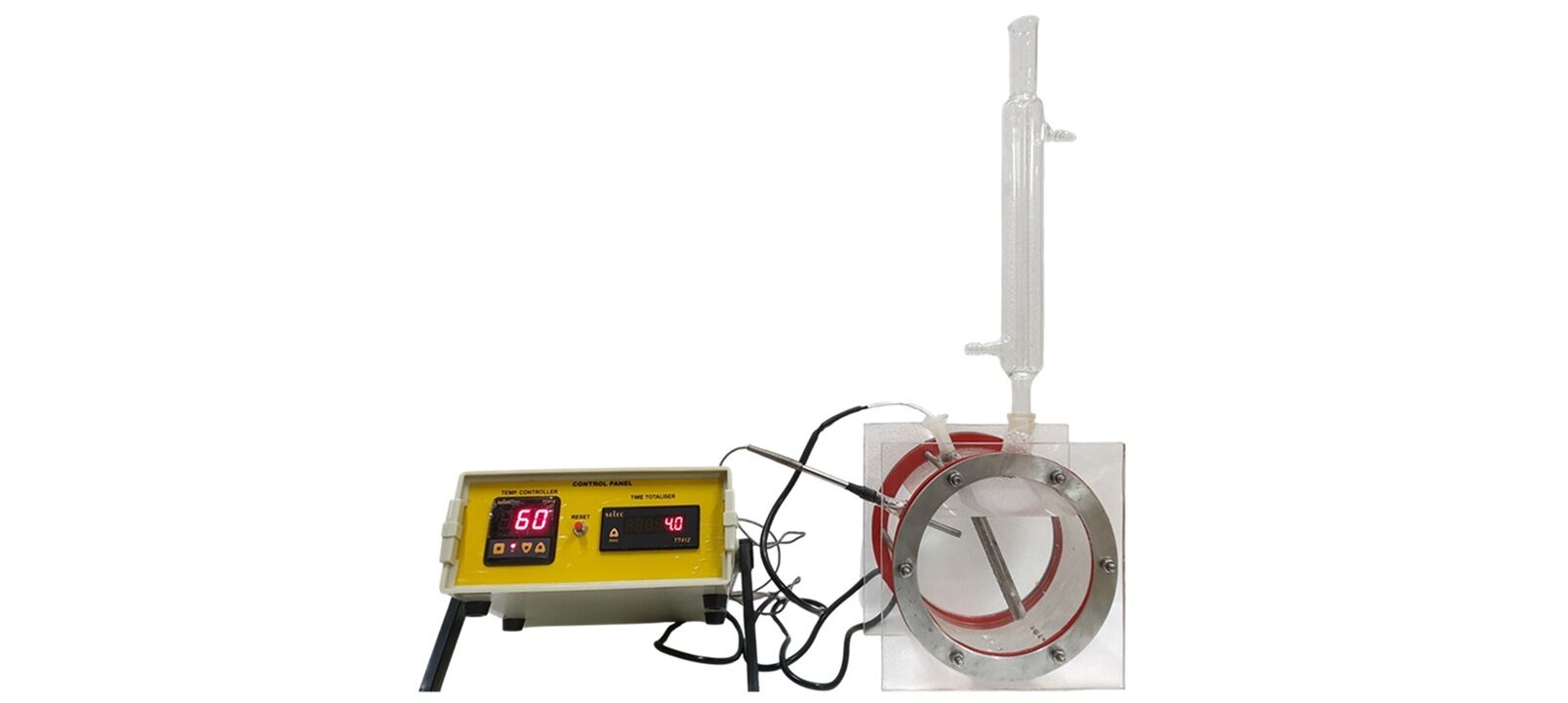
Synonyms: Atlas Cell Test Apparatus, NACE TM0174, Corrosion Testing, NACE Corrosion Test, AMPP
Caltech India is the manufacturer and supplier of Atlas Cell Test Apparatus – NACE TM0174, which is a laboratory test method for evaluating the performance of protective coatings and linings in immersion service, where they are exposed to harsh chemical and thermal conditions. The procedure includes two main test methods: one-sided panel testing (often called the “Atlas Cell” test) and complete immersion of a coated panel.
This method is a standard, Laboratory Test Methods for the Evaluation of Protective Coatings and Lining Materials on Metallic Substrates in Immersion Service Procedure A for testing and outlines the necessary parameters. The latest version is the 2022 standard from Association for Materials Protection and Performance (AMPP), formerly NACE International.
Procedure A: One-sided panel (Atlas Cell) testing
This method is specifically designed to evaluate a coating’s resistance to the “cold wall effect,” which occurs in tanks and vessels when there is a significant temperature difference between the internal liquid and the external steel surface.
Specimen: A coated metallic panel (commonly 200 x 200 x 5 mm) is prepared. One side is coated with the test material to a specific thickness, while the other side is left uncoated.
Apparatus: A glass cylinder (Atlas Cell) is clamped against the coated side of the panel, leaving the uncoated side exposed to ambient air.
Procedure: The test liquid, which simulates the intended service environment, is placed inside the glass cylinder and heated to the specified temperature. The setup creates a thermal gradient where the coated surface is hot and the uncoated metallic surface is cold.
Simulated effects: This temperature difference accelerates the permeation of aggressive chemicals through the coating and simulates how moisture might condense on the steel surface, which can lead to blistering, disbondment, and adhesion loss.
Evaluation: After the test duration (typically 1, 3, or 6 months), the coating is inspected for visible failures like blistering, cracking, or softening. Adhesion is also tested using methods such as the pull-off test (e.g., ISO 4624).
Specimen preparation: Substrates (e.g., steel, aluminum, copper) must be properly prepared, including abrasive blast cleaning, to a specific surface profile. Coatings must be applied according to the manufacturer’s specifications for thickness and cure time.
Pre-test properties: Key physical properties of the coating, such as dry film thickness, durometer hardness, and pencil hardness, are measured before the test begins.
Post-test evaluation: After the exposure period, the panels are removed, and the coating is re-evaluated for any changes in its physical properties. Adhesion testing is a critical part of this evaluation.
Test conditions: The standard provides recommendations for test duration, temperature, and specific test specimens. The chemical composition of the immersion fluid should simulate the actual service environment.
NACE TM0174 does not define a single temperature range for testing. Instead, the standard provides laboratory test methods for evaluating protective coatings in immersion service, and the test temperatures must be selected to replicate the specific service conditions of the application.
Normally Testing is carried as below:
60°C (140°F): Used for immersion testing in water for 6 months for epoxy coating of steel.
95°C (203°F): Used for testing coating systems in de-ionized water in an Atlas Cell.
85°C (185°F): Used in a pressurized Atlas Cell test simulating an oil and gas environment.
71°C (160°F), 82°C (180°F), and 93°C (200°F): Used in a two-stage test for tank linings in biofuel production based on project specifications.
Ordering Information:
CES 1750 – Atlas Cell Test Apparatus – NACE TM0174
In India, we have various customers from Mumbai, Delhi, Bangalore, Chennai, Hyderabad, Ahmedabad, Kolkata, Surat, Pune, Jaipur, Lucknow, Kanpur, Nagpur, Visakhapatnam, Indore, Bhopal, Patna, Vadodara, Ghaziabad, Ludhiana, Coimbatore, Madurai, Nashik, Srinagar, Aurangabad, Dhanbad, Allahabad and Ranchi in India.
We also export our range of products to worldwide countries like USA, Canada, Chile, United Kingdom – UK, Spain, Germany, Italy, Dubai, Abu Dhabi, U.A.E, Oman, Saudi Arabia, Singapore, Kuwait, Iran, Indonesia, Thailand, and many more as well.
